 Bordeaux Wine Day Tour
The Monolithic Church of Saint-Émilion
The monolithic church of Saint-Émilion is an entire church carved down into a limestone hill, and you cannot walk into it on your own. Every visit goes with a guide from the tourist office, which runs an underground tour through the church, the hermitage, the Trinity Chapel and the catacombs. This guide covers what the church is, how it was dug, what the tour costs, how the bell tower climb works and how to fit it into a Saint-Émilion day from Bordeaux. For the wider choice of wine day trips, see the comparison of Bordeaux wine day tours.
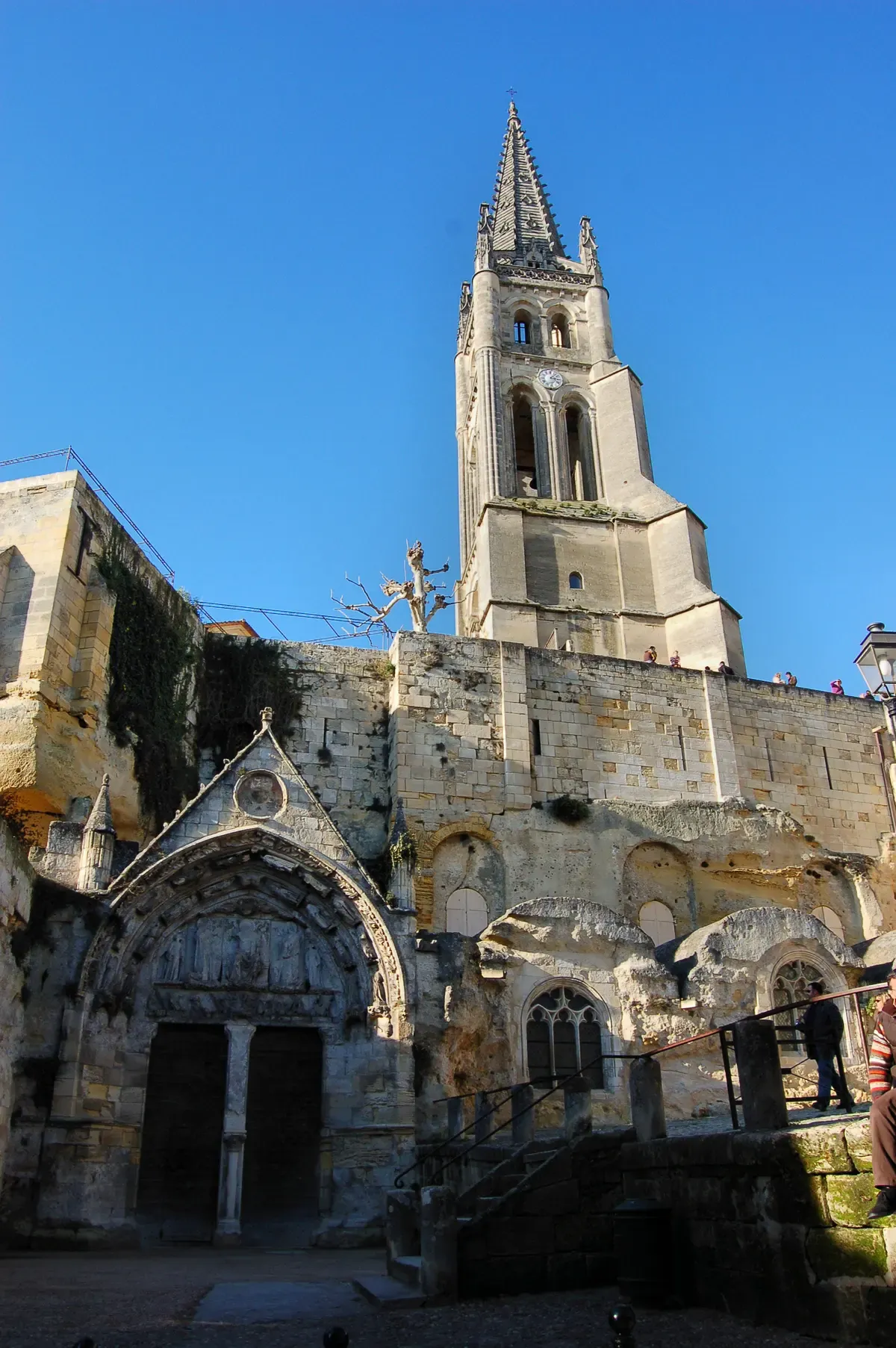
The bell tower and carved portal of the monolithic church in Saint-Émilion. Photo: Fabien1309, CC BY-SA 2.0 fr, via Wikimedia Commons
Quick answer The church in one line
The monolithic church of Saint-Émilion is an 11th to 12th century church carved out of limestone rock, visited only on the tourist office's underground tour, which costs €11 per adult and lasts about 1 hour.
Key takeaways
- Plan the rest of the village with the Saint-Émilion guide.
- The Saint-Émilion Village and Grand Cru Half Day includes a guided village walk, but the listing does not mention a church ticket.
- Doing it yourself? The train from Bordeaux to Saint-Émilion takes about 30 minutes.
A Church Dug Out of the Rock
Saint-Émilion grew around one man's cave, and the cave grew into one of the largest underground churches in Europe.
The Hermit and the Digging
The story starts with Emilion, a Breton hermit who settled in a natural cave in the limestone cliff in the 8th century. He died in 767, and his disciples dug a first underground passage around his tomb. Pilgrims came, and the settlement that grew around the cave took his name.
The church itself was carved in the late 11th or early 12th century, probably as a large reliquary church for the crowds of pilgrims around the tomb. The tourist office's press kit dates the digging to the start of the 12th century. One local heritage guide says Viscount Pierre de Castillon oversaw the excavation in its current form. The rock is Asteria limestone about 30 million years old, soft enough to cut and stable enough to hold a roof. The name comes from Greek words meaning single stone, because the whole building is one block of rock, floor, pillars and ceiling together. Nothing was built. Everything was taken away.
After that the building had a rough ride. It was painted in the 14th century, devastated in the 16th, and in 1793 revolutionaries turned it into a saltpetre factory, which destroyed what was left of the wall decoration. It was restored in the 20th century and French Wikipedia gives its classification as a historic monument in 1886 and 1907, while the town page lists the tower as classified in 1883.
How Big Is It, and the Stabilisation Work
The official figures from the tourist office are 38 m long and 12 m high. Other sources disagree on the height: French Wikipedia and Guide Bordeaux Gironde put the central nave at 11 m, and English Wikipedia describes the main hall as 38 m long and 20 m wide. The length of 38 m is the one figure every source agrees on. Digging it out removed about 15,000 m³ of rock. Inside there is a nave and two aisles in six bays, separated by pillars cut from the same single block. One inscription on the third southern pillar is cited in dating debates, along with a dedication date of 7 December, but the exact years remain uncertain.
By the 1990s the church was in real structural trouble, with water infiltration threatening the pillars. It was placed on the World Monuments Watch in 1996, experts met in 1998, and tensile bands were inserted into the pillars. The church reopened to the public in 2006. That 1996 to 2006 stabilisation is the last documented major work on the building, and no later restoration closure has been announced. The historic centre around it has been UNESCO listed since December 1999, the first vineyard landscape inscribed as a cultural landscape. Today the church anchors a village of about 1,600 residents that draws close to a million visitors a year, a contrast the Saint-Émilion guide helps you plan around.
Sources: Saint-Émilion tourist office, Guide Bordeaux Gironde, World Monuments Fund
The Underground Tour
Access to the underground church is strictly by guided tour from the tourist office. Self-guided visits are not permitted at any time.
What the Tour Covers
One ticket covers four linked monuments under and around the square. The tour starts at the tourist office at Le Doyenne, Place des Créneaux, and moves through the spaces in sequence. Here is what you see in each part, as described by the tourist office and the heritage guides.
| Part | What you see |
|---|---|
| Emilion's hermitage | The 8th century cave where the hermit lived, carved into the limestone cliff around his tomb |
| Trinity Chapel | A carved chapel with medieval wall paintings |
| The catacombs | Underground passages and burial galleries |
| The monolithic church | The 38 m underground church itself, with its nave, two aisles and monolithic pillars |
Prices, Times and the Rules
The individual ticket costs €11 per adult for groups of 1 to 9 people, €10 per person for groups of 10 or more, €8 for students aged 18 and over, and €6.50 for children aged 3 to 18. One note on group size: the tourist office fiche says up to 50 people per group, while the boutique booking page says 1 to 35, so expect a group somewhere in that range.
The booking page gives the visit as 1 hour, the tourist office press kit says about 45 minutes, and a bilingual visit takes 1h30. Tours run in French and English, with written translations in 11 other languages available on request at the tourist office. The tour runs daily all year except 25 December and 1 January, and booking in advance is mandatory. Private versions exist before 9:00 or after 19:00, with guide fees of €100 Monday to Saturday, €115 on Sundays and holidays, and €160 outside those hours.
Three rules matter. First, late arrivals cannot join the underground part of the tour and are not refunded, so leave slack in your schedule. Second, photography is prohibited during the visits, underground and throughout. Third, the underground temperature stays around 10 to 13 C all year, so bring a layer even in summer. The tour is not sold on this site. You book it directly with the Saint-Émilion tourist office.
The Monolithic Church and Its Bell Tower
The tourist office's own film of the church and its bell tower. Third-party video by Saint-Emilion Tourisme. This site did not shoot it and has no relationship with the creator.
Climbing the Bell Tower
The spire above the church is a separate ticket and a separate effort, but the view over the roofs and vines is the payoff.
Price, Steps and Height
The bell tower climb costs €2 per person, paid separately, and it is not included in the underground tour ticket. For safety it requires at least 2 visitors, so a solo traveller may have to wait for company. You borrow the key from the tourist office, where four keys exist, and the visit is unaccompanied, with an average visit time of about 30 minutes.
The tourist office counts 196 steps up to a 360 degree view and puts the tower at 68 m, the highest bell tower in Gironde after Saint-Michel in Bordeaux. Sources disagree on the height: French Wikipedia and the World Monuments Fund say 53 m, and Guide Tourisme France says 70 m. The 196 steps are consistent across sources. The tower was built between the 12th and 15th centuries, with Gothic windows and a portal added in the 14th century and the spire in the 16th. Buy the ticket and borrow the key at the tourist office at Place des Créneaux, the same desk that runs the underground tour, so it is easy to pair the two in one stop.
Sources: Saint-Émilion tourist office
Fitting the Church Into a Wine Day
Most visitors arrive on a bookable wine day trip from Bordeaux. Here is the honest fit between those tours and the underground church.
Which Tours Give You Time in the Village
Three things to know before you book. First, several Bordeaux wine day tours that visit Saint-Émilion include a guided walk through the village. Second, none of the listings names the tourist office underground tour as part of the day. Third, if the church is the reason you are going, book the €11 underground tour yourself for a slot that fits around your wine day, or come by train on a separate day.
Among the village-focused options, the Saint-Émilion Village and Grand Cru Half Day costs $95 and includes a guided walk through medieval Saint-Émilion plus one château tasting in 4 to 4.5 hours. The Saint-Émilion Day Trip with Sightseeing Tour and Wine Tastings costs $182.70 and gives 8 hours with 3 châteaux and a guided village walk. The Saint-Émilion Half-Day Wine and Walking Tour costs $84 for 5 hours with a village walk and one Grand Cru Classé tasting. Check each listing for how much free village time it leaves. For the full side-by-side view, see the comparison table on the homepage. Getting there on your own is simple too, since the train from Bordeaux to Saint-Émilion runs in about half an hour.
Questions About the Monolithic Church
What is a monolithic church?
A monolithic church is a church carved out of a single mass of rock rather than built from blocks. At Saint-Émilion the whole building, pillars included, was cut down into the limestone, removing about 15,000 m³ of rock. Read the full history in the Saint-Émilion guide.
How long is the Underground Saint-Émilion tour?
The booking page gives 1 hour, the tourist office press kit says about 45 minutes, and the bilingual visit takes 1h30. Adult tickets cost €11. Details and rules are in the underground tour section.
How do I get tickets for the monolithic church of Saint-Émilion?
You book the underground tour in advance with the Saint-Émilion tourist office at Le Doyenne, Place des Créneaux, where the tour also meets. Booking is mandatory and late arrivals are not refunded. If you come on a wine day trip instead, the Saint-Émilion Village and Grand Cru Half Day listing does not mention the church ticket.
Can you visit the monolithic church without a guide?
No. Access to the underground church is strictly by guided tour and self-guided visits are not permitted. The only unguided option is the bell tower climb at €2, where you borrow the key from the tourist office. The train from Bordeaux to Saint-Émilion makes an independent visit easy to arrange.
Is the monolithic church visit suitable for people with limited mobility?
Not really. The tour and the tower both involve stairs and uneven rock, and the tourist office area counts only 3 members labelled Tourisme et Handicap. Wear sturdy shoes for the steep cobbles of the village. The Saint-Émilion guide covers the terrain in more detail.