 Bordeaux Wine Day Tour
Pauillac Wine: The Town, the Gravel and the First Growths
Pauillac wine is the reference point of the Left Bank. This small town on the Gironde estuary, 45 to 51 km from Bordeaux by road, holds three of the five 1855 First Growths, 18 classified growths in total and around 1,200 hectares of vines where Cabernet Sauvignon rules. This guide covers the appellation, the gravel terroir, the three famous châteaux and their visit policies, the town itself with its wine office and the village of Bages, and how to reach the area from Bordeaux by car or on a Médoc day tour. If you want the full wine day tours from Bordeaux, the homepage holds the side-by-side table.
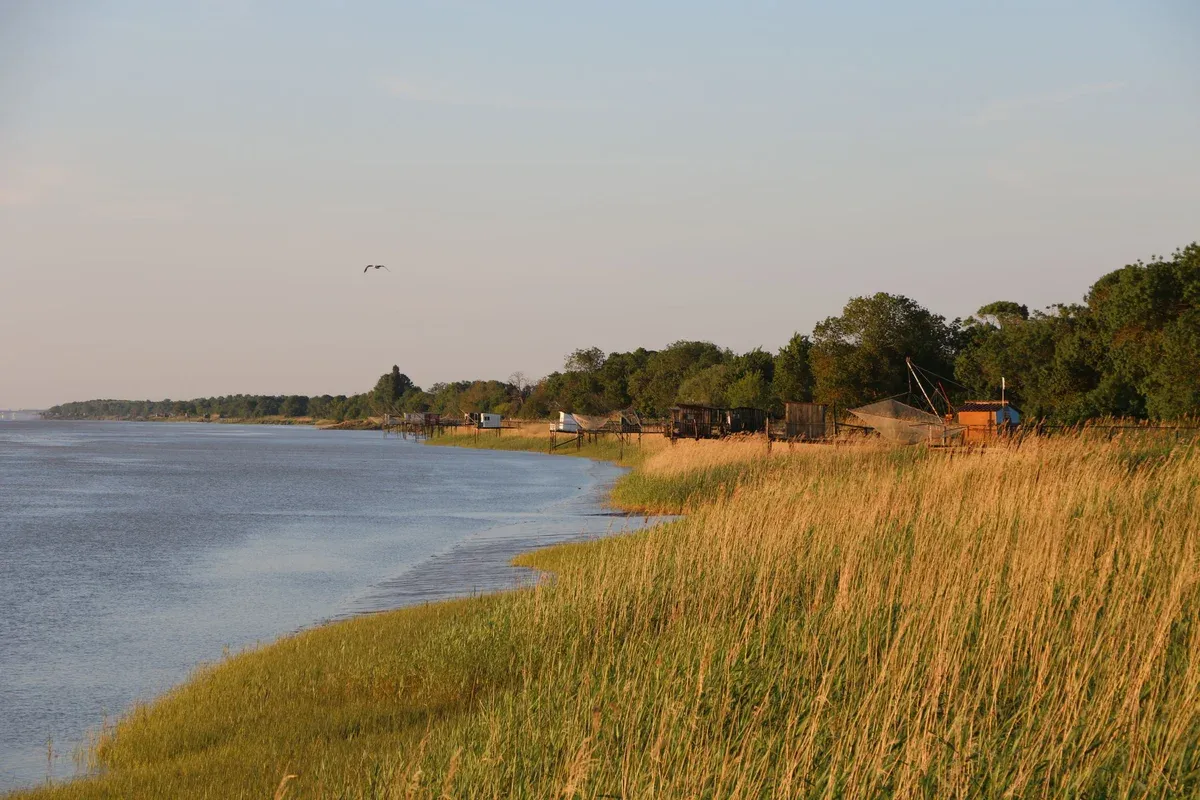
Reed beds and fishing huts on the Gironde estuary at Pauillac. Photo: Anthony Baratier, CC BY-SA 4.0, via Wikimedia Commons
Quick answer Pauillac in brief
Pauillac is a communal appellation of the Médoc, holding 3 of the 5 First Growths and about 1,200 ha of vines on gravel, 45 to 51 km north-west of Bordeaux. Its wines are Cabernet-led, with blackcurrant, pencil shavings and cigar box notes.
Key takeaways
- The appellation spans about 1,222 ha with 47 growers, and Cabernet Sauvignon is predominant in every red. See the appellation in figures.
- Lafite Rothschild, Latour and Mouton Rothschild all sit inside one commune. Their visit policies differ sharply. See Three First Growths in One Commune.
- Public transport barely reaches the Médoc, so most visitors drive the D2 or book a tour such as the Médoc Full-Day Wine Tour. See Getting to Pauillac.
- For the other bank, read the guide to Saint-Émilion and the overview of Bordeaux wine regions.
Pauillac in Figures
The numbers behind the most famous communal appellation of the Médoc, drawn from Wikipedia, the châteaux and the CIVB.
The Appellation by the Numbers
Pauillac sits midway between Bordeaux and Pointe de Grave, on the left bank of the Gironde estuary. The commune covers 22.74 km2 and counted 5,190 inhabitants in 2023. The AOC itself was recognised in 1936 and is one of the six communal appellations enclosed by the wider Haut-Médoc.
The table pulls together the core figures for the appellation and its terroir, from official AOC data, the estates themselves and reference encyclopedias.
| Fact | Figure |
|---|---|
| Vineyard area | 1,222 ha planted in 2023 (about 1,200 ha per Mouton Rothschild) |
| Growers | 47 in 2023 |
| Production | 59,055 hl, average yield 48 hl/ha |
| AOC recognised | 1936 |
| Classified growths | 18: 3 First, 2 Second, 1 Fourth, 12 Fifth |
| Distance from Bordeaux | 45 km to about 51 km by road |
| Vineyard land value | EUR 3 million per hectare average in 2023 (EUR 2.2 to 4.5 million range) |
| Commune population | 5,190 in 2023 |
Cabernet on Gravel
Six red grapes are permitted in Pauillac and Margaux: Cabernet Sauvignon, Merlot, Cabernet Franc, Petit Verdot, Malbec and Carmenere. Cabernet Sauvignon is predominant. The gravel soils store heat by day and radiate it back at night, which suits a grape that buds and ripens late, one to two weeks after Merlot. Latour and Mouton Rothschild are known for blends with some of the highest Cabernet shares in Bordeaux, often around 75%. Petit Verdot, which ripens very late, is used mostly in the Médoc, in small amounts for tannin, colour and flavour.
The taste profile is well documented. Pauillac wines show blackcurrant, pencil shavings and cigar box, a direct consequence of Cabernet on warm gravel. If you compare banks, the Right Bank inverts the ratio: a typical Saint-Émilion blend is about 70% Merlot, while a Left Bank blend runs about 70% Cabernet Sauvignon. The full grape picture is in the guide to Bordeaux wine regions.
Sources: Saint-Émilion Tourist Office, Bordeaux wine, Wikipedia
Three First Growths in One Commune
Pauillac holds three of the five 1855 First Growths.
Lafite, Latour, Mouton
The 1855 classification, created for the Exposition Universelle in Paris at the request of Napoleon III, ranked 61 red estates. Five reached First Growth rank. Three of them stand on Pauillac gravel: Lafite Rothschild, Latour and Mouton Rothschild.
Around them sit 15 more of the 60 Médoc estates of the classification, spread through 18 classified growths in total. The table sets out what each of the big three is and, crucially, what it offers a visitor, from the châteaux's own statements and Wikipedia.
| Château | 1855 rank | Visitor note |
|---|---|---|
| Lafite Rothschild | First Growth | 178 ha with 116 ha in vines per French Wikipedia, bought by James de Rothschild in 1868 (English Wikipedia says 107 ha). No public visit policy in the sources, plan well ahead. |
| Latour | First Growth | About 50 km from Bordeaux and 300 m from the estuary. Visits are offered primarily to professionals and only by appointment, office open Monday to Friday except public holidays. |
| Mouton Rothschild | First Growth (since 1973) | Open Monday to Friday by appointment only, closed weekends and holidays. Book at least two months ahead. Tours with tasting last two to two and a half hours. |
| Second Growths (context) | Second Growth | Pauillac holds 2 Second Growths within its 18 classified estates, per the 1855 list. |
| Lynch-Bages | Fifth Growth | 90 ha next to Pauillac, Cazes family since 1938. Tied to the village of Bages. |
The Artist Labels of Mouton
Mouton Rothschild is the only estate ever promoted in the 1855 classification. It moved from Second to First Growth in 1973 by a decree signed by Jacques Chirac, then Minister of Agriculture. Its motto changed from 'Premier ne puis, second ne daigne, Mouton suis' to 'Premier je suis, Second je fus, Mouton ne change'. The vineyard covers about 90 ha, planted 81% Cabernet Sauvignon, 15% Merlot, 3% Cabernet Franc and 1% Petit Verdot.
The labels are a story of their own. After the Allied victory in 1945, Baron Philippe de Rothschild asked Philippe Jullian to draw the 'V for Victory' label, and since then each vintage has carried an original artwork by a contemporary artist. Picasso, Dali and Miro are among the names commissioned from 1946 onward, while French Wikipedia dates the artist labels from 1945. The estate also keeps the Museum of Wine in Art in a former barrel hall, holding 17th century German gold and silverware, medieval tapestries, ivories, glassware and porcelain. If the First Growths are booked out or closed, a group tour remains the practical route onto the gravel. The Saint-Émilion and Médoc Day with Lunch runs the Route des Châteaux in the afternoon with tastings, and Château Margaux has its own guide.
Lynch-Bages, Pontet-Canet and Bages
Not every visit to Pauillac has to aim at the First Growths. Lynch-Bages, a Fifth Growth covering 90 ha just outside the town, is planted 73% Cabernet Sauvignon, 15% Merlot, 10% Cabernet Franc and 2% Petit Verdot. The Cazes family has owned it since 1938 and bought neighbouring Château Haut-Batailley in 2017. The estate is tied to the village of Bages.
Pontet-Canet is another Fifth Growth with a reputation beyond its rank. French Wikipedia gives it 81 ha in Pauillac. English Wikipedia gives the estate 120 ha in total with 80 ha in vines, split 60% Cabernet Sauvignon, 33% Merlot, 5% Petit Verdot and 2% Cabernet Franc, owned by Guy Tesseron since 1975. No official tasting prices for any Pauillac château appear in the sources, so treat any figure you see elsewhere with caution and check with the estate.
Pauillac in 5 Minutes
A wine expert on Pauillac and its châteaux. Third-party video by Bonner Private Wines. This site did not shoot it and has no relationship with the creator.
The Town on the Estuary
Pauillac is a working town with a wine office, a quay and a marina, and the village of Bages nearby.
Quay, Port and History
The town hall stands at 1 quai Antoine Ferchaud, open Monday to Friday 8:30 to 12:30 and 13:30 to 17:15, which tells you where the civic centre of Pauillac sits: on the water. From the 19th century, heavy industry lined the Gironde here, and the estuary port sent transatlantic liners to South America until the Second World War, after which it became an oil terminal. The marina, called Pauillac La Fayette, dates from 1977 and sits in the muddy tidal zone known as the 'bouchon vaseux', so boats may wait several hours to enter at big tides.
The name recalls the Marquis de Lafayette, who sailed from Pauillac in 1777 to support American independence. Every September the Marathon du Médoc runs through the town's wine country, mixing running with tastings along the route.
The Maison Du Tourisme Et Du Vin
The Pauillac Maison du Tourisme et du Vin sits at La Verrerie, 33250 Pauillac, and is the practical first stop in town. The town hall site gives its hours as Monday to Saturday 9:30 to 12:30 and 14:00 to 18:30, Sunday 10:30 to 12:30 and 15:00 to 18:00. Note that these hours carry no date on the page, so confirm by phone before you plan a late arrival.
Behind the Maison starts the 'Randonnée des Châteaux', a walking route through the vines. Visit policies at the châteaux change, so check each estate directly.
The Village of Bages
Bages, next to Pauillac, centres on Place Desquet between the Lynch-Bages cellars and the Cordeillan-Bages hotel. The village holds Cafe Lavinal, a 1930s style brasserie opened in 2006 and named after Berthe Lavinal, grandmother of Jean-Michel Cazes, plus Bages' Bazaar, a butcher called Boucherie de Bages and a bike workshop. Château Cordeillan-Bages is a 28-bedroom Relais & Chateaux hotel dating to 1989, a short walk through the vines away, built as a 19th century 'chartreuse' that kept 17th century turrets.
For a full day combining this bank with the right bank, Saint-Émilion and Médoc pairs both, and if you extend your trip the monolithic church of Saint-Émilion makes a natural second day.
Getting to Pauillac
The Médoc is poorly served by public transport. A car or an organised tour is the realistic option.
Distance and Drive Time from Bordeaux
Sources disagree slightly on the distance. A wine blogger puts Bordeaux to Pauillac at 45 km and about 45 minutes in normal traffic, over an hour in heavy traffic. Château Latour and the route calculators put it at about 50 to 51 km and about 56 minutes, mainly via the D206 and Avenue du Médoc.
The honest summary is 45 to 51 km and 45 minutes to an hour depending on traffic and route. The D2, nicknamed the Route des Châteaux, runs from Margaux through Saint-Julien-Beychevelle and Pauillac on to Saint-Estèphe. France Today says the D2 takes a good 90 minutes to cover without stops, and one travel site stretches it at about 50 km along the peninsula, though another count puts the road at closer to 80 km from end to end.
The blogger calls it a single-lane road that jams, and advises grouping your visits in one appellation and driving north to south. Margaux, the southernmost communal appellation, is about 30 km from Bordeaux and about 40 minutes by car.
Tours That Reach the Médoc
Because the Médoc is poorly served by public transport, most visitors without a car book an organised tour. Several listings on this site cover the Médoc on left-bank routes. The Médoc Full-Day Wine Tour runs 8 hours with 3 winery visits, all tasting fees included, adults only, from $182.70.
It starts at 9:30 AM in front of the Bordeaux Tourist Office and lunch is not included, so plan to eat beforehand. The Saint-Émilion and Médoc Day with Lunch runs 9 hours with 3 château visits and a picnic lunch at a Saint-Émilion winery, from $222.66. For a shorter taste of the left bank there is also a Médoc Half-Day Wine Tour at $106, and the full comparison of Bordeaux wine day tours sits on the homepage in one table.
Pauillac Questions
What kind of wine is Pauillac?
Pauillac wine is a red Left Bank Bordeaux from a communal appellation recognised in 1936. Six grapes are permitted, Cabernet Sauvignon, Merlot, Cabernet Franc, Petit Verdot, Malbec and Carmenere, and Cabernet Sauvignon is predominant. Typical blends run about 70% Cabernet, and the wines show blackcurrant, pencil shavings and cigar box. See the guide to Bordeaux wine regions for the whole map.
Why is Pauillac expensive?
Scarcity and reputation both play in. The appellation is only 1,222 ha with 47 growers, and it holds 3 of the 5 First Growths plus 18 classified growths in total. French Wikipedia records Pauillac vineyard land at an official average of EUR 3 million per hectare in 2023, against EUR 40,000 for Listrac and EUR 70,000 for Moulis, which shows how the market prices the name. The Médoc Full-Day Wine Tour lets you taste the style without buying a bottle first.
What is the best wine from Pauillac?
The 1855 classification answers by rank rather than by taste: three Pauillac estates hold First Growth status, Lafite Rothschild, Latour and Mouton Rothschild, and Mouton was promoted in 1973 in the only change ever made to the list. The appellation also holds 2 Second Growths and 12 Fifth Growths. Rank is not a tasting note, but it is the only independent ranking in the sources. Compare a day among them on the wine day tours from Bordeaux.
Can you visit the Pauillac First Growths?
Only with planning, and not all on equal terms. Mouton Rothschild receives visitors Monday to Friday by appointment, closed weekends and public holidays, with booking at least two months ahead and tours of two to two and a half hours. Latour states its visits are offered primarily to professionals and only by appointment. No public visit policy for Lafite appears in the sources. An organised route such as the Saint-Émilion and Médoc Day with Lunch visits three châteaux for you, though the listing does not say they are First Growths.
How do you get to Pauillac from Bordeaux without a car?
With difficulty. The sources describe the Médoc as poorly served by public transport, so most visitors need a car or an organised tour. By road Pauillac is 45 to 51 km from Bordeaux, about 45 minutes to an hour depending on traffic, via the D2 Route des Châteaux. The Médoc Full-Day Wine Tour leaves from the Bordeaux Tourist Office and needs no car at all. For the contrast, Bordeaux to Saint-Émilion is an easy train run.