 Bordeaux Wine Day Tour
Bordeaux Wine Regions Map: Left Bank, Right Bank and Entre-Deux-Mers
The Bordeaux wine regions map splits into three parts along two rivers and an estuary. This guide shows which region sits where, which grape each bank plants, how far each appellation is from the city and which bookable day tours reach it. Bordeaux has about 110,000 hectares of vines across 65 appellations per CIVB, so a map earns its place. The bookable tours are compared on Bordeaux wine day tours.
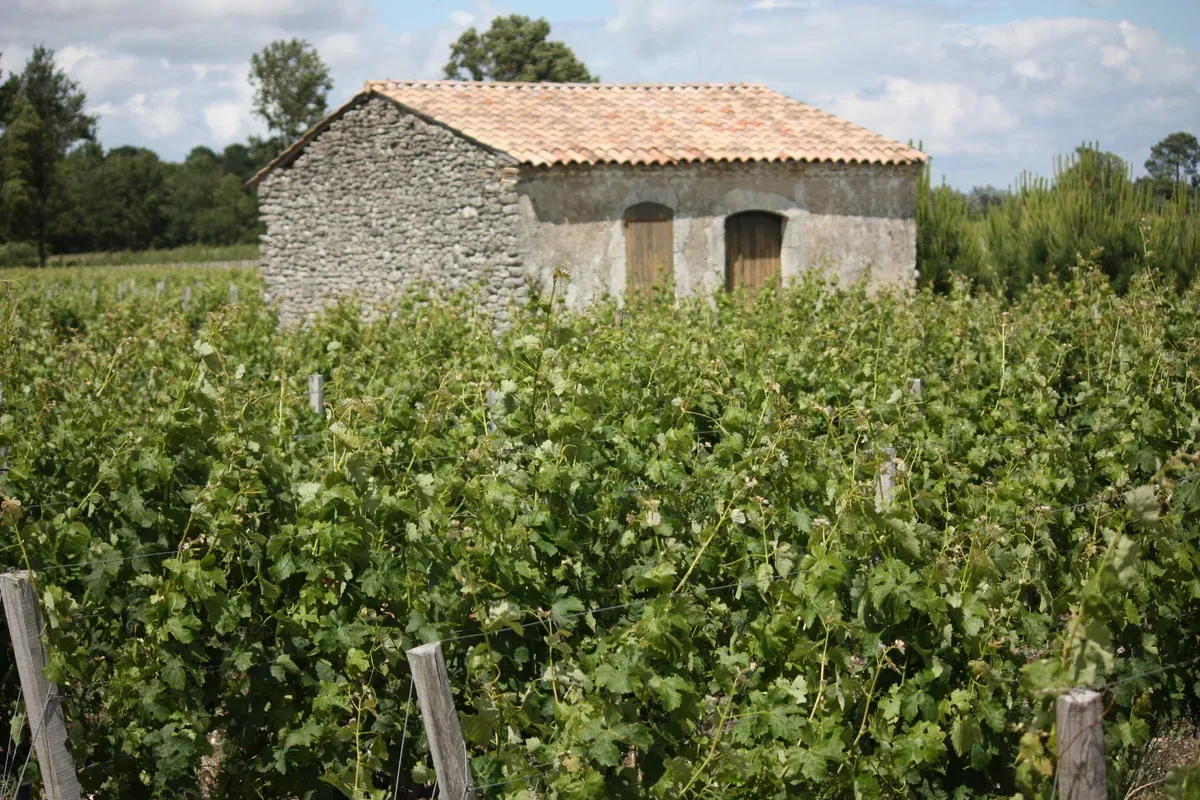
A stone vineyard hut in Moulis-en-Médoc. Photo: Medocpleinsud, CC BY-SA 4.0, via Wikimedia Commons
Quick answer The map in one line
The map of Bordeaux wine regions is drawn by the Gironde estuary and its two rivers, the Garonne and the Dordogne, which divide the vineyard into the Left Bank, the Right Bank and Entre-Deux-Mers. Saint-Émilion on the Right Bank is about 40 km from Bordeaux by the tourist office's count (other sources say 35 to 49 km), Margaux on the Left Bank about 30 km.
Key takeaways
- Left Bank, Right Bank and Entre-Deux-Mers: the three parts of every Bordeaux wine regions map are set by water, not by taste.
- Grapes follow the banks: Cabernet Sauvignon leads the Left Bank, Merlot leads the Right Bank.
- Check which day tour reaches which region before you book, since no single half day covers both banks.
- The closest vines to the city are in Pessac-Léognan, which its syndicate says are reachable in just under 20 minutes from the centre.
The Bordeaux Wine Regions on One Map
Appellations, villages and a few famous châteaux, coloured by bank. A larger marker means a day tour on this site goes there, and the list under the map holds the same places.
-
Bordeaux (Place des Quinconces)
No tourPlace des Quinconces covers about 25.6 ha and was laid out from 1816 to 1820. The Monument aux Girondins on it is 54 m tall.
No guided tour stops here. Self-drive only.
-
La Cite du Vin
No tourWine museum at 134 Quai de Bacalan with an 8th floor Belvedere 35 m up and a 3,000 m2 permanent exhibition.
No guided tour stops here. Self-drive only.
-
Saint-Emilion
6 of the toursUNESCO site since 1999. The appellation covers about 5,400 ha and the town had 1,608 residents in 2023.
Stops here: From Bordeaux: Half Day Saint-Emilion Wine Tour and Village, Saint Emilion Day Trip with Sightseeing Tour and Wine Tastings from Bordeaux, From Bordeaux: Half-Day Saint-Emilion Wine Tour with 8 Wines, Saint-Émilion Afternoon Tour with 2 Grand Crus and French Apéritif, Saint-Emilion Electric Bike Day Tour with Wine Tastings and Lunch, From Bordeaux: Saint Emilion Half-Day Wine and Walking Tour
-
Pomerol
1 of the toursAbout 780 ha under vine (French Wikipedia), described as the smallest wine-producing area in Bordeaux (about 800 ha in English Wikipedia), with no official classification. The commune had 608 residents in 2023.
Stops here: Saint-Émilion and Pomerol Wine Tour: Tastings, Lunch and WSET Guide
-
Libourne
No tourFounded around 1269 at the confluence of the Isle and Dordogne, with 25,036 residents in 2023 and a station on the Bordeaux line.
No guided tour stops here. Self-drive only.
-
Fronsac
No tourFronsac and Canon-Fronsac have 170 owners and growers, average estate 7 ha and no chateau classification. The commune had 1,130 residents in 2023.
No guided tour stops here. Self-drive only.
-
Castillon-la-Bataille
No tourSite of the Battle of Castillon on 17 July 1453, last battle of the Hundred Years War. 3,344 residents in 2023.
No guided tour stops here. Self-drive only.
-
Margaux
3 of the toursMargaux AOC covers 1,519 ha in four communes. About 25 km and 36 minutes by car from Bordeaux. Margaux-Cantenac had 2,845 residents in 2023.
Stops here: From Bordeaux: Full Day Wine Trip to St Emilion and Margaux, Bordeaux: Half-Day Margaux Tour with Wine Tastings, From Bordeaux: Medoc and Margaux Wine Tour and Gourmet Platter
-
Saint-Julien-Beychevelle
No tourSaint-Julien AOC covers about 920 ha with no First Growth. The commune had 606 residents in 2023.
No guided tour stops here. Self-drive only.
-
Pauillac
No tourPauillac AOC has 1,222 ha (2023) and three First Growths. 51 km and about 56 minutes by car from Bordeaux, 5,190 residents in 2023.
No guided tour stops here. Self-drive only.
-
Saint-Estephe
No tourNorthernmost Medoc communal appellation at about 1,230 ha. The commune had 1,638 residents in 2023.
No guided tour stops here. Self-drive only.
-
Listrac-Medoc
No tourListrac AOC covered 635 ha in the 2000 to 2010 decade, set a little back from the estuary. 2,807 residents in 2023.
No guided tour stops here. Self-drive only.
-
Moulis-en-Medoc
No tourMoulis AOC covered 630 ha in 2008, slightly smaller than Listrac's 635 ha. 1,962 residents in 2023.
No guided tour stops here. Self-drive only.
-
Lesparre-Medoc
No tourSub-prefecture and main town of the Bas-Medoc, with 5,872 residents in 2023.
No guided tour stops here. Self-drive only.
-
Pessac (Haut-Brion)
1 of the toursSecond-largest suburb of Bordeaux with 67,339 residents in 2023. Tram line B ends at Pessac Centre, opened 29 May 2007.
Stops here: Graves and Saint-Emilion Wine Tour with 3 Châteaux and Gourmet Picnic
-
Leognan
No tourHome of Carbonnieux, Chevalier, Fieuzal, Haut-Bailly, Malartic-Lagraviere and Olivier among the 14 classified Graves growths. 10,670 residents in 2023.
No guided tour stops here. Self-drive only.
-
Sauternes
No tourSauternes AOC covers 1,416 ha in five communes (2023). The commune had 788 residents in 2023 and Maison du Sauternes stands at 14 Place de la Mairie.
No guided tour stops here. Self-drive only.
-
Barsac
No tourBarsac AOC has 333 ha (2023) and 47 producers, and its growers may also label wine Sauternes. 2,058 residents in 2023.
No guided tour stops here. Self-drive only.
-
Cadillac-sur-Garonne
No tourFounded in 1280 as a river port, across the Garonne from Sauternes, with 2,670 residents in 2023. Known for sweet Cadillac AOC wines.
No guided tour stops here. Self-drive only.
-
Creon
No tourBastide created in 1315, in the heart of the Entre-Deux-Mers, with 4,950 residents in 2023.
No guided tour stops here. Self-drive only.
-
Blaye
No tourVauban citadel, a UNESCO site since 2008, 56 km north of Bordeaux with a small ferry to Lamarque. 5,066 residents in 2023.
No guided tour stops here. Self-drive only.
-
Bourg
No tourCotes de Bourg had 2,918 ha of red and 42 ha of white claimed in 2023. The town had 2,244 residents in 2023.
No guided tour stops here. Self-drive only.
-
Chateau Margaux
3 of the tours265 ha estate with about 87 ha of red vines and 12 ha of white. Visits by appointment Monday to Friday, tasting for professionals only.
Stops here: From Bordeaux: Full Day Wine Trip to St Emilion and Margaux, Bordeaux: Half-Day Margaux Tour with Wine Tastings, From Bordeaux: Medoc and Margaux Wine Tour and Gourmet Platter
-
Chateau Lafite Rothschild
No tourPauillac First Growth, bought by James de Rothschild in 1868. Vineyard size is 107 ha (English Wikipedia) or 116 ha (French).
No guided tour stops here. Self-drive only.
-
Chateau Mouton Rothschild
No tourPromoted to First Growth in 1973, and its Museum of Wine in Art sits in a former barrel hall. Labels have carried original art since 1945.
No guided tour stops here. Self-drive only.
-
Chateau Latour
No tourL'Enclos is 47 ha, only 300 m from the Gironde, with 900,000 vines. Visits are primarily for professionals by appointment.
No guided tour stops here. Self-drive only.
-
Chateau d'Yquem
No tourThe only Sauternes rated Premier Cru Superieur in 1855. LVMH took control in 1999.
No guided tour stops here. Self-drive only.
-
Chateau Cheval Blanc
No tourSaint-Emilion Premier Grand Cru Classe A since 1955 on 41 ha with 57% Cabernet Franc, bought in 1998 by Bernard Arnault and Albert Frere.
No guided tour stops here. Self-drive only.
-
Chateau Haut-Brion
No tourThe only 1855 First Growth outside the Medoc, in Pessac, on 51 ha. Owned by Domaine Clarence Dillon since 1935.
No guided tour stops here. Self-drive only.
Left Bank, Right Bank and Between the Rivers
Three bodies of water make the map. Once you see them, every appellation falls into place.
The Rivers That Draw the Map
The Garonne runs 529 km and flows through the city of Bordeaux. The Dordogne runs about 483 km, passes Libourne and Castillon-la-Bataille, and is famous for a tidal bore called the mascaret. The two meet at the Bec d'Ambes just downstream of central Bordeaux and form the Gironde estuary, described as the largest estuary in Western Europe at about 635 km2 and 3 to 12 km wide.
Those waters split the vineyard into three. The Left Bank is the west side of the Garonne and the Gironde, home to the Médoc, Graves, Pessac-Léognan and Sauternes. The Right Bank is the east side of the Dordogne, home to Saint-Émilion, Pomerol and Fronsac. Entre-Deux-Mers lies between the Garonne and the Dordogne. Its name means 'between two tides', a nod to the rivers rather than seas.
Grapes by Bank
The banks grow different grapes because the soils differ. Left Bank gravel stores and radiates heat, which suits late-ripening Cabernet Sauvignon. A typical Left Bank blend runs about 70% Cabernet Sauvignon, 15% Cabernet Franc and 15% Merlot. Pauillac estates such as Latour and Mouton Rothschild often push Cabernet Sauvignon to around 75%.
Right Bank clay suits Merlot, which ripens up to two weeks earlier than Cabernet Sauvignon. A typical Right Bank blend is about 70% Merlot, with Cabernet Franc taking a larger role here than on the Left Bank. Pomerol runs to roughly 80% Merlot (Wine Folly says about 85%) and Saint-Émilion about 60%. Across all Bordeaux, CIVB data puts red varieties at 89% of plantings, led by Merlot at 66% (Wikipedia gives 62%), and whites at 11%, split between Sémillon and Sauvignon at 46% each in the CIVB figures. The appellation area has shrunk recently, from 103,000 ha to about 95,000 ha in 2024 according to Wikipedia.
Sources: Saint-Émilion Tourist Office, Bordeaux wine, Wikipedia
Every Region at a Glance
The table below condenses the Bordeaux wine regions map into one view. Distances come only from published sources, so several cells say not stated.
Regions, Grapes and Distances From Bordeaux
Each row links to the full page for that region, where the visiting details live. Read the map script below the text for positions. The Haut-Médoc encloses six communal appellations, so its rows share one bank and one grape.
Barsac producers may label their wine as Barsac or Sauternes.
| Region | Bank | Main grape | From Bordeaux | Page |
|---|---|---|---|---|
| Médoc / Haut-Médoc | Left | Cabernet Sauvignon (52% of Haut-Médoc plantings) | about 45 to 50 km to Pauillac depending on the source | Pauillac |
| Margaux | Left | Cabernet Sauvignon | about 30 km, about 40 minutes by car | Château Margaux |
| Pauillac | Left | Cabernet Sauvignon | about 50 km to Mouton Rothschild | Pauillac |
| Saint-Julien | Left | Cabernet Sauvignon | not stated | Pauillac |
| Saint-Estèphe | Left | Cabernet Sauvignon | not stated | Pauillac |
| Graves / Pessac-Léognan | Left | Cabernet Sauvignon and Sauvignon Blanc | just under 20 minutes from the centre, per the Pessac-Léognan syndicate | Graves wine |
| Sauternes / Barsac | Left | Sémillon (80% of the blend) | about 40 km south-east (Wikipedia), 47 km to the Maison du Sauternes (Gironde tourism) | Sauternes wine |
| Saint-Émilion | Right | Merlot (about 60% of the blend) | 35 to 49 km depending on the source, about 30 minutes by road | Saint-Émilion |
| Pomerol | Right | Merlot (about 80%) | about 3.4 km from Libourne station, 12 km from Saint-Émilion | Pomerol wine |
| Entre-Deux-Mers | Between | Sauvignon Blanc and Sémillon (dry white) | not stated | Bordeaux wine regions map |
Sizing the Regions
The areas differ wildly. Pomerol is the smallest in Bordeaux at about 800 ha. Margaux covers 1,413 ha in five villages (French Wikipedia gives 1,519 ha in four communes) and its grapes ripen 7 to 10 days earlier than elsewhere in the Médoc.
Pauillac has about 1,200 ha, Saint-Estèphe about 1,230 ha and Saint-Julien about 920 ha. Pessac-Léognan covers more than 1,800 ha according to its syndicate (English Wikipedia gives 1,580 ha), and the Graves AOC stretches about 55 km from Bordeaux to Langon across 42 communes. Saint-Émilion covers about 5,400 ha (the tourist office says about 5,000), roughly 6% of the regional vineyard, plus four satellite appellations.
Only about 5% of the total vineyard belongs to classified growths, so most of the map is unclassified wine.
The Basics of the Bordeaux Wine Region
The banks, rivers and appellations of Bordeaux. Third-party video by Elicité. This site did not shoot it and has no relationship with the creator.
Which Day Tour Reaches Which Region
Most bookable day tours from Bordeaux serve one bank per day. The table shows the region each tour covers and its listed starting price. The full comparison with durations, group sizes and inclusions sits on the Bordeaux wine tours comparison.
Regions and the Tours That Cover Them
A comparison guide says Saint-Émilion works as a half day and the Médoc needs a full day, though half-day Margaux and Médoc tours are listed too. Only full-day tours cross both banks. Prices are the starting prices from each listing.
| Region | Day tours | From |
|---|---|---|
| Saint-Émilion | Half Day Village and Grand Cru, Day Trip Three Châteaux, 8 Wines Half Day, Afternoon Two Grands Crus, E-Bike Wine Day, Half Day by Wikitour | $95, $182.70, $106, $119.90, $211.25, $84 |
| Margaux and Médoc half days | Half-Day Médoc, Margaux Half-Day, Médoc and Margaux Gourmet Platter | $106, $101, $100 |
| Full Médoc | Médoc Full-Day | $182.70 |
| Both banks | Saint-Émilion and Margaux Full Day, Saint-Émilion and Médoc with Lunch, Médoc and Saint-Émilion Three Châteaux | $202, $222.66, $223 |
| Graves and Saint-Émilion | Graves and Saint-Émilion Picnic Day | $199.83 |
| Saint-Émilion and Pomerol | Saint-Émilion and Pomerol with WSET Guide | $182.70 |
Choosing by Region
If Merlot is the goal, pick Saint-Émilion or the combined Pomerol day. If Cabernet Sauvignon on gravel is the goal, pick the Médoc or Margaux. Only one listing is built around Pomerol, the Saint-Émilion and Pomerol with WSET Guide at $182.70 for 6 hours, and the Half Day by Wikitour at $84 drives through the Pomerol appellation without a stop there.
For Sauternes and Entre-Deux-Mers, no group day tour from the city is listed on this site, so those regions are currently do-it-yourself trips, and Sauternes wine explains how.
Bordeaux Wine Regions Map: Questions
Can you show me a map of Bordeaux wines?
The interactive map sits near the top of this Bordeaux wine regions map page, above the regions table. The text around it names the three parts, the 10 main appellations and their distances from the city so you can read the map without zooming.
How many vineyards are there in Bordeaux?
CIVB data counts about 5,500 winegrowers across about 110,000 ha, with Wikipedia listing more than 5,660 producers. The regions they farm are laid out on the Bordeaux wine regions map.
What is the prettiest town in the Bordeaux wine regions?
Saint-Émilion is the usual answer, a UNESCO-listed village of about 1,600 residents (the tourist office counts about 1,876) with an 11th-century church carved from limestone. The Saint-Émilion guide and the monolithic church page cover the visit.
What are the five red wines from Bordeaux named on the 1855 map?
The five 1855 First Growths are Lafite Rothschild, Latour and Mouton Rothschild in Pauillac, Margaux in Margaux, and Haut-Brion in Pessac-Léognan. Pauillac alone holds three of them, as the Pauillac page details.
Which region is closest to the city of Bordeaux?
Pessac-Léognan in the northern Graves. Its syndicate calls the vines 'vines in the city' and says they are reachable in just under 20 minutes from the centre. See Graves wine for châteaux and access.